Thursday, January 10, 2019

MacClassics Student's Excavation in Italy

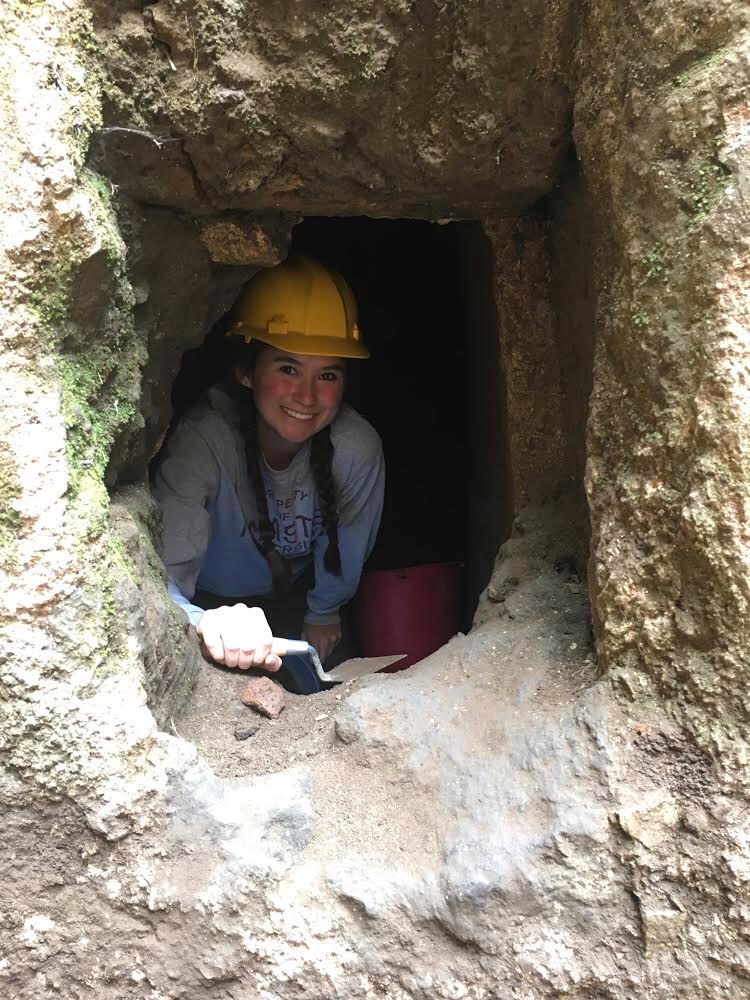
McMaster Classics Major Shanna Ingram participated on an archaeological excavation at Ceverteri, ancient Caere, in Italy across summer 2018. The MacClassics Blog is grateful for this guest submission on her experience:

Ms. Ingram on the dig
A remarkable and mysterious civilization dominated Italy for centuries. The Romans knew them as the Etruscans, who referred to themselves as Rasenna. They inhabited ancient Etruria, occupying central Italy in the region that is currently known as Tuscany. They quickly achieved a wealth of power in the 6th century BC with newfound trade relations, advancements in engineering, and exemplary artistry. The Etruscans passed on much of this expertise and had a profoundly formative role in the rise of their Roman counterparts. Their art and architecture permeated into Roman culture and can still be seen today.

The excavation at Caere


Last summer I had the opportunity to enroll as a field school student with Queen’s University. We dug on an Etruscan site located in the plateau of Caere, now modern-day Cerveteri. It is famous for its well-preserved necropoleis of rock-cut tombs. Relatively little is known about the Etruscans and most of the research in modern scholarship comes from tomb finds. My excavation was unique in that we examined their urban and religious infrastructure. Our team looked at three major areas: an urban grid, the “hypogaeum of Clepsina”, and a cavaedium. I learned so many different archaeological techniques each day. Digging in the trench, surveying, finds sorting, and pottery sketching just to name a few. My Indiana Jones moment came when, trowel in hand and headlamp on, I embarked into a newly opened tunnel leading out of the cavaedium.

I had no prior field experience before this dig. All I knew was that I loved classics and had a good work ethic that could be applied in an excavation setting. It turned out to be a phenomenal learning experience. I encourage any and all students, if you’re the slightest bit intrigued, to volunteer on an archaeological dig one day. 

Drone view of the work
 For more information on the excavation, go to www.caeresite.com

Monday, July 6, 2015

Athenian Wealth and the Parthenon


I recently had the opportunity to deliver a paper at the Annual Meeting of the Classical Association of Canada as part of a team researching the Athenian Acropolis. Peter Schultz, David Scahill and I presented, “The Parthenon’s Attic: The Management and Location of Public Treasures in Athens in the Fifth century BC.”

Here is the abstract:

More is known about the public finance of Athens than any other city in the Classical period. However, despite the existence of numerous decrees on civic monies, many mysteries remain regarding the management and location of Athens’ public treasures.

Athens’ principal repository, the Treasury of Athena, is associated with a space known as the “Opisthodomos.” This designation seems to refer to two discrete locations on the Athenian Acropolis; the epigraphical evidence also makes clear that goods belonging to the treasury were spread out across multiple buildings and numerous rooms. Before 407 BC, inscriptions locate public goods in the “Opisthodomos” (perhaps the reconstructed inner rooms of the Old Temple of Athena) and in spaces often identified as rooms of the Parthenon: the “Pronaos,” the “Hekatompedon,” and a location named “the Parthenon.” After 407 BC, the treasury and its associated spaces underwent significant re-organization, perhaps in response to the burning of the Opisthodomos of the Old Temple of Athena. At this time, Pheidias’s great temple proper became the principal seat of the Athenian treasury.
Annual inventories of public and sacred property reveal that the interior of the Parthenon was filled with a wide range of objects ranging from the extremely valuable (gold crowns) to the dubious (rotten arrows) (Harris 1995). Conspicuously, missing from the inventory accounts, however, are the coins and bullion that constitute the vast majority of the city’s wealth. Ancient sources (Thuc. 2.13.3-4; Diod. Sic. 12.40.1-2, 12.54.3, and 13.21.2) describe amounts between 8,000 and 10,000 Talents held in the treasury. The Kallias decree also specifies that 3000 Talents in Athenian coinage was placed in the Treasury of Athena (IG I3 52, l. 3-4). While no inscriptions refer to the location of the city’s coined wealth, it has long been known that temples were used as banks (Bogaert 1968, Roux 1984). Again, the most logical location for the storage of these monies is within the Parthenon. A problem remains, however: The Parthenon’s interior was already literally packed with goods. In 1983, however, Manolis Korres published evidence for the existence of a staircase built into the Parthenon’s eastern cella wall. Like the famous staircases in several Sicilian temples, this staircase led to the temple’s attic. Safe, accessible, easily controlled, and sanctified by the goddess’s own power, this large, neglected space may have played a more central role in the Parthenon’s form and function than previously thought. 


The reaction at the conference was exactly what one hopes for: good questions that push the boundary of our understanding and insightful points of view that I overlooked in the delivery. One part of the response, however, was unexpected. Owen Jarus of Livescience covered the conference and featured the work on their website. The story subsequently got picked up by other outlets including Yahoo NBC Newsand even To Bema, a Greek daily newspaper. The full academic publication is in the works and will appear soon. 


Wednesday, June 11, 2014

Congratulations to 2014 Classics Graduates


Congratulations to McMaster Humanities graduates and the Classics Department Class of 2014. Convocation marks the completion of formal education for many of us and provides the occasion to look forward to new endeavours as professionals. Commensurate with this transition, now is the time to put all of the exercises of the last four years into practice . This liminal moment brings to mind words used to describe Charles Eames, one of the godfathers of midcentury modern design and an artist with an enormous legacy. He adhered to the theory that in professional endeavours one should not sell one’s extant skill set, which is a limited repertoire, but instead sell yourself based on the things you don’t know, which is an unlimited repertoire. Sell your desire, your drive, your ability to learn, and your enthusiasm to successfully complete tasks at hand. In this way, you are never unprepared or unqualified. 


This perspective is central to a Humanities degree. While there are a few professional settings that require you to know the date of the Kritios Boy, the skills employed to identify, scrutinize, and prepare a rigorous analysis of the sculpture will contribute to any undertaking. These tools are essential to building your value in your community, your city and your professional setting. Curiosity, drive, and stick-to-itiveness are the skills for success in Classics, and they are the same that will ensure it continues beyond the university.

Congratulations. 


Friday, June 6, 2014

The Great Beauty, Part I


The first half of 2014 might be considered a good moment for Classics on film. The 300: Rise of Empire revives the great battles of the early Classical period (although I am not sure exactly which empire the title refers to: is it Athens? Sparta? Hollywood? Here I feel a bit like Croesus must have at Delphi). Pompeii uses the eruption of Vesuvius as the dramatic backdrop for a Roman sword and sandal drama, and forthcoming films on Hercules (nee Herakles) and Hannibal promise that the ancient world will remain prominent at the megaplex for some time to come. But the film that Classicists and anyone that loves the ancient world should see is La Grande Bellezza, The Great Beauty.


The film is, well, beautiful, not the least for numerous shots of sun-drenched Rome glowing in that colour that is wholly owned by Rome and Rome alone; the film gloriously captures the Eternal City shining its brilliant yellow-tinted reddish hue from apartments, palaces, and rooftops. Rome’s trademarked colour is at its most conspicuous when raking sunlight – either early in the day or just before dusk – hits its red bricks, white travertine and warm terracottas. The result creates a sense of place like no other and establishes Rome as a magnetic force. Beyond the aesthetics, watching the film is a humbling experience. It contrasts Rome’s long-lived and beautiful artistic and architectural traditions with our transience and the fact that we have but one single moment to reflect upon, embrace, and perhaps even challenge a tradition greater than us all. Only Rome could provide the historical context for a film to move us by presenting the weight of history and at the same time demonstrate that our “maiores” have wrestled with these ponderous questions long before it became our turn. As classicists, we are in a place to appreciate that history: our eyes and ears are open and we are receptive to the message because we know the value of the past. 


Rome is truly one of the protagonists (another is the incomparable Toni Servillo, who has Marcello’s ennui with Toto’s rubbery features). In the film, debates swirl around living in Rome and how it affects and ultimately changes someone. One character feels that that city is the only true expression of Marxism — Rome pulls everyone to the centre. Another felt he had to leave Rome because of the city’s unstoppable decline. Decadent Rome. Crumbling, just like the ruins of the Colosseum viewed from Jeb’s terrace, or the buildings in the Roman Forum. The great beauty of their debate is that it is anything but new. Rome was crumbling for Marcello in La Dolce Vita by Fellini, Rome was decaying for Piranesi as he made woodcuts, and Rome was certainly dying for Juvenal. Rome was in the depth of depravity for Livy, “our solutions are worse than the disease” and for Cicero, too: “o tempora o mores.” The Eternal City presents its perpetual decadence to us and continues to inspire another generation to contemplate time, life, love, death, and our place in a greater spectrum. And yes, it also makes us reflect on beauty, happiness, love, and redemption: all of those things that make living among the decay worthwhile. In one scene in which the protagonists walk through an empty Capitoline Museum (the Dying Gaul makes a guest appearance), it is clear that the price of beauty is decay. The beautiful abounds when we seek it out, recognize, and value it: cultures, artists, architects, and entire societies will eventually pass, but chasing beauty ensures that there is something preserved for the next one. It creates a tradition, which can, and has, extended for centuries. Rome’s decadence is our eternal fountainhead of inspiration.

Tuesday, March 18, 2014

Congratulations to Humanities Essay Prize Winner

Congratulations to Laura Jones (Classics `16) who was awarded the 2nd Prize in the Humanities Essay Prize Term I: 2013-14 (Level II) for her paper "Ancient Dress and Jewelry from Early Minoans to Hellenistic Greeks" written for Classics 2B03: Greek Art and Archaeology.

Ms. Jones provides a summary of her work:


The salient features of a particular culture can be reflected in the visible details of their dress and costume. Thus, the study of how the individuals of a nation dress has an ethnological significance which rationalizes a detailed exploration of it. The changes, as well as the continuity seen throughout the development of dress in the ancient world are both fascinating and educational topics. There are notable differences in dress from the Minoan period to the Hellenistic era, which can be examined through paintings, pottery, sculptures, and jewelry finds. Surprisingly, the most ancient culture that is discussed, the Minoans, had perhaps the most intricate and elaborate type of clothing in all of antiquity. An important aspect of Minoan culture is that they loved splendor and enjoyed artificial delights. The dress from this time period reflects this kind of a luxurious, stable culture. Mycenaeans borrowed most of their dress from their predecessors, the Minoans, but also added a few innovations that can be seen most vividly on pottery finds. Additionally, Archaic Greece saw many new alternatives in clothing and style preference. The well-known peplos and chiton were introduced in this period and continued for a long time, eventually creating innovations in the draping techniques later during the Classical era. The innovations in dress during the Classical period are particularly striking and are fortunately very easy to explore due to the large output of human-figured sculptures all over Greece at this time. Rather than using structure formality, stress focused on the soft fabrics which draped over the body in elegant and beautiful folds during the Classical era. Furthermore, Hellenistic Greek clothing was mostly about individuality and particularism, thus the strict ways of wearing garments disappeared. All of this development in ancient dress can be traced through several images presented throughout this essay, showing both continuity and changes. The noteworthy differences seen in Minoan dress through to the Hellenistic Greek world can be traced through various pieces of art and actual finds themselves. By exploring sculpture, frescos, pottery pieces, and even jewelry finds, one is able to draw many conclusions on that specific culture and time period. Thus, the topic of dress in the ancient realm is both intriguing and worth studying in detail.

For more information on the Humanities Essay Prize, follow this link:  http://www.humanities.mcmaster.ca/awards/essays.html

Tuesday, September 17, 2013

Thursday, August 15, 2013

Classics 2B03: Greek Art and Archaeology Sneak Preview


Viewing the Greek Art and Archaeology (Classics/Art History 2B03) class list on Avenue to Learn recently, I was pleased to see a number of familiar names and an equal number of names that will soon be attached to familiar faces. Classics 2B03 provides an overview of Greek Art and Archaeology from the Bronze Age through to the Roman Period; it is designed to provide familiarity with the material culture and specific cultural contexts of Ancient Greece. The class focuses primarily on the Archaic and Classical periods (ca. 700-323 BC), a time that corresponds with the rise and floruit of the Greek polis, and the age that witnessed the most rapid and notable developments in architecture, sculpture, coinage, and pottery.

Along the way, one of the themes of the course will be the expansion of the Greek world and the establishment of overseas settlements. We will examine the context of the foundation, the early development and the separate internal development of western Greek art and architecture. We will also explore the forces that brought the Greeks into contact with other cultures around the Mediterranean, including the Phoenicians, Persians, and Etruscans.

We will dedicate class time to that fateful year 480 BC and the bridge from the Archaic to the Classical period and the attendant political, social, religious, and artistic shifts that mark this very significant division. The High Classical period is dominated by the Periklean Acropolis, and I think I will be able to put together a Powerpoint or twelve on the topic. For the Hellenistic period, I am particularly interested in investigating new foundations and look at the pre-planned, monumental, designs as a new direction in Greek urbanism.

The goals of the course are 1) to introduce students to the major monuments of Greek antiquity and consider the context in which they were created, 2) to introduce main scholarly issues and current methodology in Greek Art and Archaeology, and 3) encourage the application of new approaches to this material.

There is one more particularly noteworthy change to the class and that is the adoption of a new textbook: Richard Neer, Greek Art and Archaeology, c. 2500-c. 150 BC, New York, Thames and Hudson, 2011 (available from the McMaster Campus Store soon). Prof. Neer’s book is a thoroughly modern textbook on Greek Archaeology that provides a broad cultural context in addition to insightful analyses of the artifacts themselves. I am looking forward to getting your feedback on the text and exploring all of Greek Art and Archaeology with you.

Thursday, July 4, 2013

The Great Gatsby and the Pantheon


All who have suffered through my Greek Art and Archaeology lectures long enough to arrive at the Archaic period know that I have a fondness for F. Scott Fitzgerald. I often recite one of the opening lines of Tender is the Night as a crutch to convey a cultural sense of the Greek Kouros, "[m]ost of us have a favourite, a heroic period, in our lives;" I employ art to explain art. 

So you can imagine that I'm pleased to see The Great Gatsby (Der Grosse Gatsby?) back in the theatre this summer. I have yet to see it, so I will spare the movie review. Beyond being pleased to see Fitzgerald -- and the Jazz Age along with him -- returning to contemporary culture, I was happy to see a broad commercial film push something of greater substance than robots that change into cars. 

Cinema, in lockstep with a good portion of contemporary culture, is cynical about our desired level of intellectual fitness. Robots that fight monsters, various flavours of the apocalypse, superheroes from other planets, superheroes that fight robots, robotized heroes that fight other robotized villains, Nitrous Oxide burning race cars, and other escapist fantasy dominate the summer movie schedule. I'll admit that the sheer spectacle of these movies is occasionally welcome, along with the popcorn and soda they are served up with; but just like the actual junk food, the mental junk food shouldn't be a central component of our diet.

(I'll spare you my condescending movie recommendations; I will not tell you that your time is better spent seeing Upstream Color, Like Someone in Love, or Beyond the Hills, because no one likes that kind of discussion. I will not even consider recommending a re-read of Fitzgerald before seeing the film.)

Instead the film got me thinking about audiences and engagement. Fast and Furious prevents us from using most of our brains -- if we did, the movie would crash just like the cars in it. Iron Man, Superman, The Avengers, and others takes us for a ride mostly as a passive passenger, and while they do dip into myth, archetypes, and lots of Joseph Campbell territory, we are wowed by spectacle more than anything else. That is, our attempt to intellectualize them will eventually lead us to a cul-de-sac named "Entertainment". On the other hand, a film such as Upstream Color pays off very little for those who don't want to do the intellectual wrestling to come to terms with it (the Sampler was Circe, right?). 

I pondered this question while walking through Rome early one morning and found a solution our problematic cultural diet. The Pantheon. One can (and thousands of visitors do) marvel at it because it is famous, because it is old, or simply because it is big. It leaves an impression. You don't need a Classics B.A. to appreciate it as a monument, and the thousands that pass by every day undoubtedly find new reasons to admire and engage with the building. It makes us feel small and temporary compared to its eternality; it makes us appreciate the best of human achievement, especially considering its age; it takes us out of the everyday and forces us to engage with masterpieces of human expression. It exemplifies humankind making its boldest statements. 

But if you do have a degree in Classics, the building never stops giving. Its significance is also indicated by the double pediment emulating the roofline of the Propylaia on the Athenian Acropolis, the octostyle porch not dissimilar from the Parthenon, and the spherical interior recalling earlier domes, both concrete and corbeled. It is subtly imbued with meaning through its metrology that links the building to the Imperial fora and the earlier building whose pedimental inscription it borrows: M AGRIPPA LF COS TERTIUM FECIT. Or perhaps the resonance is in the reception: here is the model for numerous villas of Palladio, of the Library of the University of Virgina and countless other civic and public buildings in North America. A little bit of the Pantheon's DNA can be found in the hulking concrete designs (and Brutalist designs) of the twentieth century: Frank Lloyd Wright's Googenheim in Manhattan, or Oscar Niemeyer's national congress building in Brasilia, or even McMaster's own Health Sciences Building.

Whatever your level of engagement, investigations of the Classical World will fulfill your query and push you forward just enough to inspire you to know a little more. This is one of the beauties of studying Classics: it will give as much as you take, and provide something of value at every step along the way. 
Thursday, June 13, 2013

Congratulations to Mac Classics Graduates!


Congratulations to all Mac Classics Graduates, ever shall your names, honours, and praises remain.


Mac Classics graduates were recognized by the Faculty of Humanities with numerous awards. Congratulations to Ms. Naomi Neufeld and Mr. Owen Phillips, who placed first and second for the Dean's Medal for Excellence in the Humanities. Ms. Neufeld and Mr. Phillips were also both awarded the A.G McKay Prize in Classical Studies. Ms. Neufeld is presently excavating at Cerveteri, Italy and Mr. Phillips recently co-curated the Antiquities exhibition at the McMaster Museum of Art :  http://www.mcmaster.ca/museum/exhibitions_schedule.html. Both students will return to Mac in the Fall to undertake graduate studies in the Department of Classics.


Monday, June 10, 2013

Studying Culture and Creating Culture, or Why Apotropaic Cupcakes Matter


Classics 735 Graduate Seminar in Winter 2013 examined the relationship between a city and its countryside (asty and chora); we examined the foundation of apoikiai in the eighth century BC and border conflicts across the Classical period, the installation and use of extramural and intramural sanctuaries, and discussed new foundations and developments with the city in the Archaic and Classical periods. Our investigations took us to the Argive Heraion; the Athenian Acropolis; Delphi and the poetics of Colonization; the Achaean apoikiai of southern Italy; intramural sanctuaries and the use of public space in Syracuse, Megara Hyblaia, Selinus and Akragas; the greek-indigenous border in Sicily; Aitna and the court of Hieron with Pindar and Aeschylus; and the frontier contested by Athens and Thebes. 

The beautiful thing about a seminar is that not only did we examine a culture, but also created one. 

To Kill a Mockingbird's Atticus Finch summarized cross examination by stating that you never ask a question that you don't already know the answer to. A seminar is different. we are all participants -- instructor and students (both roles exist in name and attendance-taking only) alike work together because there is something we don't fully understand and with it academic territory to convert from unknown to known. In this pursuit, there is strength in numbers; by dividing up the material into areas, each seminar member can make a contribution that builds to a greater understanding. To see seminar members feed off one another and collectively create an understanding is to see success take flight. It begins with providing a question, bibliography, and a foundation level of knowledge regarding how these questions are treated in scholarship today, but then develops in its own direction shaped by the investment and involvement of the members. When that collides with an ethos that binds everyone, the results move from satisfactory to sublime. To get a group of students to care about an angle or view or theory that they had not been familiar with before (territoriality, the significance of Pindar at Syracuse, the location of Xouthia) is good, when that expands into caring enough to create apotropaic-anti evil eye cupcakes, it is even better.

Sunday, November 25, 2012

Award Winning Mac Classics Students

Congratulations to Mac Classics Major Mr. Brendan Palangio on being awarded 3rd place in the Classical Association of Canada's undergraduate essay competition. The essay, "'Books from the Ships' and Editors of Homer: The Library of Alexandria and Ptolemaic Cultural Hegemony," was written for Dr. Corner's 2LB3 History of Ancient Greece II. Mr. Palangio comments:

"In this paper, I explored the underlying political function of the Library of Alexandria, namely it's goal of achieving a Ptolemaic hegemony over Greek literary culture. I examined the Ptolemaic imperialist policy of zealously gathering, hoarding, and copying books as to house under one roof the entirety of Greek culture. I also analyzed the workings of library scholars, such as, Zenodotus of Ephesus, Callimachus of Cyrene, Apollonius of Rhodes and Aristophanes of Byzantium. I examined their efforts in cataloging, 'correcting', and commenting on works, and how these efforts created and perpetuated a Ptolemaic hegemony over literature in the Hellenistic age. Finally, I explored how the library acted as a connection to the Greek homeland, and a unifying force for Greeks in an alien world."

More information on the award can be found here: 

http://cac-scec.ca/wordpress/activities/competitions/eng_essay-contest/


The Faculty of Humanities at McMaster University also has an undergraduate essay award prize; information can be found here: http://www.humanities.mcmaster.ca/awards/essays.html


Congratulations also to Ms. Naomi Neufeld (Mac Classics `13), who recently presented the results of her Undergraduate Student Research Award at the USRA Poster Session. Ms. Neufeld (above, left, with 2011 USRA winner Owen Phillips and Classics Club Executive Emily Lemond) investigated the acculturative forces on Etruscan Culture in the Archaic period. Her research including participating in an archaeological excavation at Cerveteri (Italy) and visiting numerous archaeological sites and museums in Tuscany and Umbria. More information on the USRA can be found here: 
http://www.humanities.mcmaster.ca/awards/usra.html